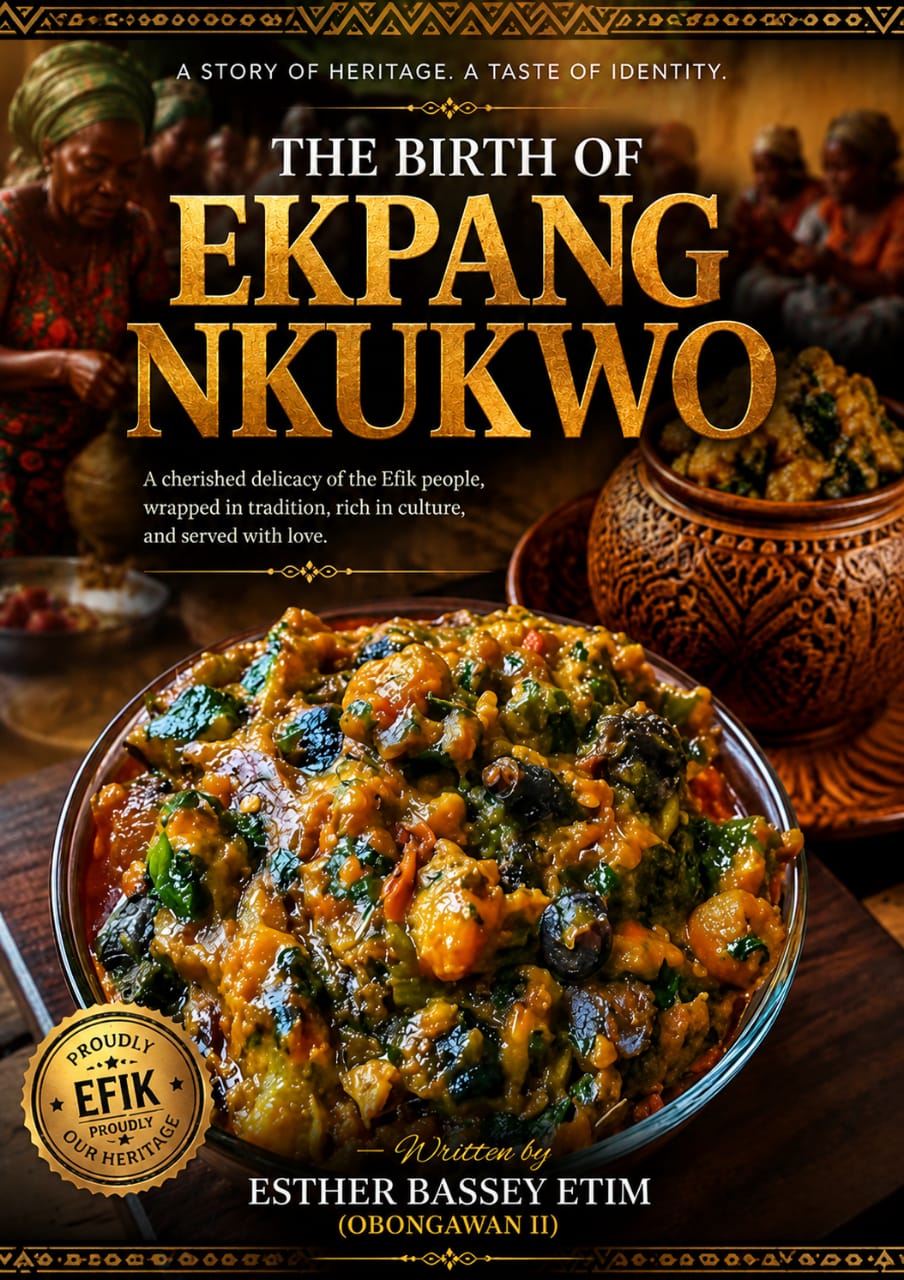
THE BIRTH OF EKPANG NKUKWO


The old storytellers often say that every great meal has a story.
Some are remembered.
Others are forgotten.
But there are a few whose stories are carried by the wind, whispered by rivers, and retold around evening fires long after the storytellers themselves have become ancestors.
This is one of those stories.
Many centuries ago, nestled between emerald forests and quiet creeks, stood a peaceful Efik village called Obio Iwang.
The people of Obio Iwang were known far and wide for their kindness, hospitality, and unity. Their fishermen returned each morning with baskets overflowing with fish. Hunters never came home empty-handed. Their farms produced cassava, yam, cocoyam, vegetables, and fruits in abundance.
The laughter of children echoed through the village every evening.
Cooking fires burned in every compound.
No visitor ever left hungry.
The elders often said,
“As long as Obio Iwang remembers gratitude, the earth will never forget to provide.”
For many years…
That saying proved true.
Until the year everything changed.
The rains came like an army.
Day after day.
Week after week.
The rivers overflowed.
The streams swallowed the footpaths.
Farms disappeared beneath muddy water.
Fishing became dangerous.
Game animals fled deeper into the forest.
The once-proud village slowly surrendered to hunger.
Children cried through the night.
Mothers secretly skipped meals so their little ones could eat.
Strong men returned from hunting with empty hands and lowered eyes.
The cooking fires that once filled the air with fragrant smoke slowly disappeared.
The silence of empty pots became louder than the songs of birds.
At the centre of Obio Iwang stood an ancient silk-cotton tree where the elders gathered whenever the village faced great trouble.
One evening, the chief summoned everyone.
The entire village assembled beneath the great tree.
The old chief looked upon his people.
Never before had he seen so much sorrow in one place.
“My people,” he said softly,
“We have fought the river.
We have fought the forest.
We have fought the rain.
Yet today…
Our greatest enemy is hunger.”
Not a single voice answered him.
Even the children were too weak to cry.
Among those standing quietly in the crowd was an elderly widow named Effioawan.
She owned no wealth.
She commanded no title.
She had no palace.
Yet everyone respected her.
People believed she understood nature better than anyone else.
They said she never took from the earth without first thanking it.
They said she listened more than she spoke.
That night, while the village slept with empty stomachs, Effioawan wrapped a cloth around her shoulders and walked alone into the forest.
The moonlight followed her.
She crossed the flooded paths.
She stepped carefully through the tall grasses until she reached an old cocoyam farm that the floods had somehow spared.
She stood there for a long time.
Then she knelt.
Her wrinkled fingers brushed against the broad green cocoyam leaves.
She noticed how every leaf gently embraced the cocoyam beneath it, shielding it from rain and harsh sunlight.
She smiled.
“The child survives because the mother never lets go.”
Slowly, an idea began to grow.
She harvested a few cocoyams.
She carefully plucked only the youngest leaves.
Then she hurried back to Obio Iwang before dawn.
Inside her little kitchen stood an old clay pot that had served generations before her.
She peeled the cocoyam.
She grated it until it became smooth like fresh cream.
Instead of dropping it directly into the pot…
She wrapped each little portion inside a tender cocoyam leaf.
One…
By one…
Patiently.
Lovingly.
Like a mother wrapping her newborn child.
Into another pot she poured rich red palm oil.
She added crayfish pounded with a wooden mortar.
Fresh pepper.
Dry fish.
Fresh fish.
Periwinkles from the creek.
A little salt.
The aroma slowly awakened the sleeping village.
One after another, the people stepped outside.
Children sniffed the air.
Hunters followed the scent.
Women abandoned their chores.
Even the chief walked towards Effioawan’s compound.
Nobody spoke.
They simply watched.
Effioawan gently lowered each wrapped parcel into the bubbling pot.
The fire crackled.
The palm oil danced.
The aroma rose into the morning sky.
It drifted across every corner of Obio Iwang.
The village had never smelled anything so inviting.
Hours later…
Effioawan lifted the lid.
A cloud of fragrant steam escaped into the air.
The people stared in amazement.
She served the oldest elder first.
With trembling hands, he unwrapped one little parcel.
Inside was soft cocoyam that had absorbed every rich flavour from the soup.
He tasted it.
His eyes slowly filled with tears.
He looked toward the sky before speaking.
“This…
This is not food.
This is hope.”
Soon everyone received a portion.
For the first time in many months…
Children laughed again.
Mothers smiled again.
The cooking fires returned.
Songs filled the air.
Hope had found its way back to Obio Iwang.
The chief rose to his feet.
He looked at Effioawan before addressing the people.
“Today,” he declared,
“we have witnessed wisdom defeating hunger.
This meal shall never be forgotten.
Every leaf shall remind us that protection brings life.
Every wrapped parcel shall remind us that patience creates greatness.
Every pot shall remind us that unity feeds a people.”
From that day onward, the women of Obio Iwang gathered together whenever the meal was prepared.
Grandmothers taught daughters.
Daughters taught their daughters.
Stories were told.
Songs were sung.
Laughter echoed across compounds as hundreds of little parcels were wrapped by hand.
The meal became known as Ekpang Nkukwo.
Not merely because of its ingredients…
But because it reminded the people that the greatest treasures are often hidden inside the simplest things.
And so, whenever the aroma of Ekpang Nkukwo rises from a kitchen, the elders smile and say,
“Perhaps somewhere… Effioawan is smiling too.”
Because legends never truly die.
They simply find another fire around which to be told.

Written by: Esther Bassey Etim (ObongAwan II)

Author’s Note: This is a fictional, folklore-inspired story created to celebrate the cultural beauty of Ekpang Nkukwo and the Efik people. It is not the documented historical origin of the dish but a work of creative storytelling.