

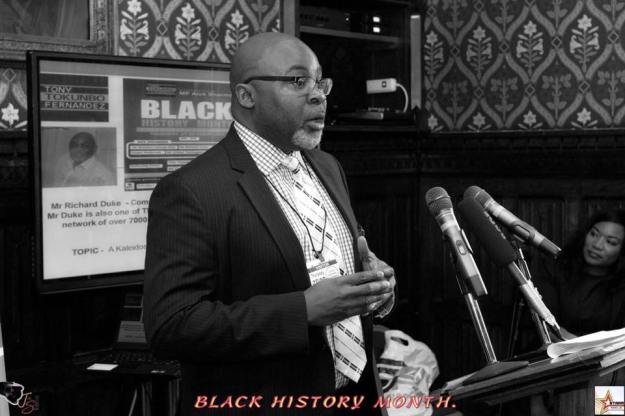
Excerpts from the transcript “A Kaleidoscope of Efik migration to the UK” presented at the Black History Month at the House of Parliament on 27/10/2016 by Richard Duke
“If history were taught in the form of stories it would never be forgotten”
Rudyard Kipling
•A little background into this presentation is that it’s part of my unpublished research work titled “The Slave Kings of Calabar, Liverpool and London”.
•As part of the Black History Month we should be able to update our knowledge about events that shaped our destiny. Many of the stories about Black History have been from a Westerners perspective but over the past decades (with the availability of digitally archived resources) Black historians have been able to tell their own story. Koomla Dumor the late BBC Africa reporter once said in a TEDx talk that “if the hunted fails to tell its own story, the story will always glorify the hunter”. This is the story of the migration of the Efik people of Calabar to the UK. 1767. Hold the thought there.
•How many of us here have never been to Africa before? Awesome!
Calabar is a coastal city in West Africa and was the capital of pre-colonial Nigeria. It was also a major slave trading port. Around 2 million out of the 10 million slaves shipped out from West Africa came from the region of Calabar (1/5th). Anyone from Jamaica in the house? In Jamaica there is a Calabar High School, I learnt it’s the best school in Jamaica. It’s named after a place called Calabar in Jamaica where ex-slaves from Calabar settled and named the place after their origin.
•If I am able to provide a short narrative about how one of the earliest African ethnic groups pioneered the migration of Africans to UK would that be a good use of our time?
•Black History Month gives us the opportunity to learn the stories of those we may not have known much about until now. So, in the
interest of deepening our well of historical knowledge, let me share with you a brief narrative about the migration of Africans from the Efik tribe of Calabar to the UK.
•The migration of Efik people to the UK had been in various waves. The first set of migrants were children of Efik Chiefs brought to the UK in the 18th century by various British slave trade ship captains as part of commercial trade arrangements to train the children in U.K. schools for a couple of years.
•The next wave of migration to the U.K. by the Efiks was in the 19th century. Lots of children of the middle class and elite in Calabar migrated to the UK in large numbers by ship from Calabar and Apapa ports. Most of them went in pursuit of education and many of them settled in U.K. without returning back. According to the shipping records archived by Ancestry.co.uk, there were over 800 travellers by sea from Calabar port to Liverpool and Bristol between 1835 and 1935, 90% were Efik migrants.
•The final wave of Efik migration took place in the 1950’s-1960’s by lots of educated Efik young adults who were looking for the next step in higher education and out of resilience took the 21 day trip by sea on the Elder Dempster ship to Liverpool.
•In 1767 seven Captains of English vessels ( 3 from Liverpool 3 from Bristol and 1 from London) berthed their ships at the shores of Old Calabar in West Africa and massacred 450 Efik people in order to double-cross their slave business partner. They also took away 500 slaves on discount and kidnapped 3 family members of the slave trading Chief.
In 1767 these 3 Efik princes were taken on a long journey through 3 different continents and finally landed in the UK, against their will. The story has been recently captured in the book ‘The Two Princes of Calabar’ by Professor Randy Sparks.
•If you don’t learn from history, history will end up teaching you a lesson. The lessons of history are not about blood, sweat and tears, it’s about learning the lessons and not allowing history to repeat itself on your watch.
•On our watch the history of migration to the UK is repeating itself again. Migrants from Africa are taking the perilous journey from Northern Africa to Europe by sea on a daily basis and are also dying at sea on a daily basis. No one in the media is talking about it, it’s our responsibility to highlight the self-enforced plight of our brothers who may never make it by sea.
•It’s time to reflect and ask ourselves if we have done enough to be part of the solution rather than complain about the problem.
•History is a social mirror which we use to project the image of the past into the future. If you don’t like what you are seeing in the mirror, as a change agent, you can realign the spectrum and impose your societal ideas.
•Conclusion:
I like playing Chess since I was 6 years old. On the Chess board, the white player always moves first. The white player always has the advantage. On a balance of probability, the White player should always win a game of chess. The White player controls the game. For the black chess player to win, they need to be more strategic and have positional awareness. The odds are stacked against them.
When you are a black player on a chess board, black is black. In the mind of the public policy makers in United Kingdom there is no Black African or Black Caribbean. To them you are just an IC3, a black crime statistic.
However, when they want to divide us, they will bring out education statistics and state that Black Africans perform better at schools than Black Caribbeans.
•You can’t compete with someone who is always one step ahead of you but you can position yourself to take advantage of your opponents situation and turn things around.
•Black History Month is always a good time to reflect and see how many pieces you have left on the chess board.
•Don’t pressurise your children by telling them that they have to work twice as hard as their white counterparts in order to get to where they are. That’s what our parents used to tell us.
•When it’s their move on the chess board teach them how to strategise, position themselves dominate their environment.
•Because when a people don’t learn the lessons from history, history has a way of teaching people lessons. May the Black History Month teach you a positive lesson and thank you very much for listening.
 TONY TOKUNBO ETEKA FERNANDEZ