
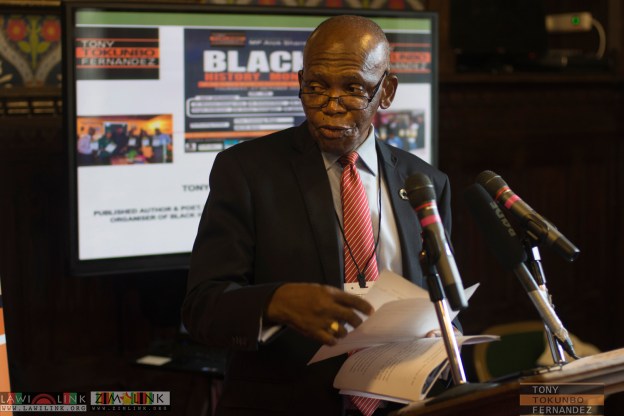
Statement by His Excellency Edward Turay at the Black History Month Event organised by TONY FERNANDEZ At the British House of Commons – London 26th October 2016
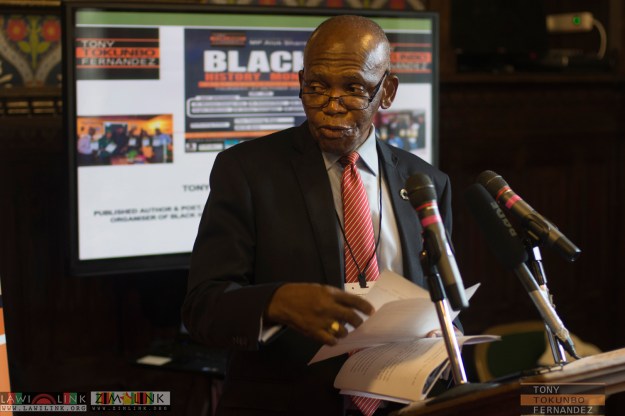
Good Evening;
I. OPENINIG
It is indeed a great pleasure and an honour for me to be here today to celebrate Black History Month with all of you.
While living in forced political exile in the United States of America, I was fortunate to become acutely aware of the importance of celebrating Black History Month. Thus I wholeheartedly commend my good friend, Tony, for promoting today’s initiative.
2
I am gratified to see that through the celebration of Black History Month, the contributions made by peoples of African descent throughout the world, continue to be remembered and honoured.
When discussing the importance of Black History Month, inevitably the legacy of slavery still holds a haunting place in our collective memory. For Africans residing in the Diaspora, especially those in the United Kingdom and America, it is an opportunity to understand the impact of slavery on the lives of those of African descent, and how this experience has impacted their perceptions about the continent of Africa and its peoples.
3
II. TRANS ATLANTIC SLAVE TRADE AND Sa. LEONE.
I will now limit me to brief commentary on the nexus of the Trans Atlantic Slave Trade and Sierra Leone.
A). Sierra Leone slave experience
Sierra Leone is a country in West Africa, that is bordered by Guinea to the north and east, Liberia to the southeast, and the Atlantic Ocean to the west and southwest. It covers a total area of approximately 72, 000 km 2 (28,000 sq mi) [ and has a population of 6.5 million ]
4
European contacts within Sierra Leone were among the first in West Africa. In 1462, Portuguese explorer Pedro da Cintra mapped the hills surrounding what is now Freetown Harbour, naming shaped formation Serra de Leão (Portuguese for Lion Mountains). The Italian rendering of this geographic formation is Sierra Leone, which became the country's name.
Soon after Portuguese traders arrived they were joined by the Dutch and French; all of them using Sierra Leone as a trading point for slaves. In 1562, the English joined the trade in human beings when Sir John Hawkins shipped 300 enslaved people, acquired 'by the sword and partly by other means', to the new colonies in America.
Between about 1750 and 1800, Bance Island in Sierra Leone was one of the major slave trading operations on the Rice Coast of West Africa. Bance Island (now Bunce) is located in
5
the Sierra Leone River about twenty miles above modern Freetown. It is a small island, only one-third of a mile long and uninhabited today, but in the days of the Atlantic slave trade it was an economically strategic point. Because Bance Island was at the limit of navigability for ocean-going vessels, it was the natural meeting place for European slave traders arriving in large sailing ships and African traders following the rivers down
from the interior.
As early as 1672 the Royal African Company of England established a commercial fort on Bance Island, also concentrated heavily on supplying slaves to one particular market—Charlestown, South Carolina where local rice planters were eager to purchase slaves from Sierra Leone and the neighboring areas.
It should be noted that In 1787 the British helped 400 freed slaves from the United States, Nova Scotia, and Great Britain return to Sierra Leone to settle in what they called the "Province of Freedom. This settlement was joined by other groups of freed slaves and soon became known as Freetown.
In 1792, Freetown became one of Britain's first colonies in West Africa. Thousands of slaves were returned to or liberated in Freetown.
Most chose to remain in Sierra Leone. These returned Africans- or Krio as they came to be called– were from all areas of Africa. Cut off from their homes and traditions by the experience of slavery, they assimilated some aspects of British styles of life and built a flourishing trade on the West African coast.
A). Effects and Legacy of Sierra Leone slave experience
Sierra Leone was not immune to the dastardly effects of the slave trade. The effects included:
Loss of population:
7
Millions of Africans were lost. The strong, fit, young individuals were mostly desired.
Society was disrupted:
Tribal wars were frequent
Laws were changed, making crimes punishable by slavery
People felt insecure
Little development or modernization took place
Cities were destroyed:
Population in cities decreased as people fled the cities to avoid being captured
Without cities civilization suffers It was dangerous to live in large groups
Africans were looked upon as inferior:
Africa was seen as a source of cheap labour
Blacks were thought of as being less intelligent
Overall Impact:
8
Slavery destroyed our civilization, which is a root cause of the underdevelopment of the continent of Africa today. No society can afford losing its youth for four hundred years without paying an enormous price.
During a ceremony to commemorate the 220 th anniversary of Britain’s banning of the trade in slaves from Africa, Ghana’s former President John Kufor noted that: “ . . .through this dark era of human history, the…human spirit…could not be broken," he said. He added: "Man should never descend to such low depths of inhumanity to man as the slave trade ever again."
At the same ceremony South Africa’s jazz legend Hugh Masakela blamed the slave trade for Africa’s current economic and social woes:
9
"We have seen the manipulation, the impoverishment of Africa…That is [proof of] the effects of slavery… There is no price, no price for what has been done,"
British Prime Minister Tony Blair sent a recorded message expressing "deep sorrow and regret" for Britain's role in the slave trade.
III. CONCLUSION
In concluding, I again commend TONY for promoting today’s initiative and thereby providing us an opportunity to remember and honour the memory of our people, as we often say in Sierra Leone, “If you do not know where you came from, you sure won’t know where you are going.
Thank you for your attention.
 TONY TOKUNBO ETEKA FERNANDEZ